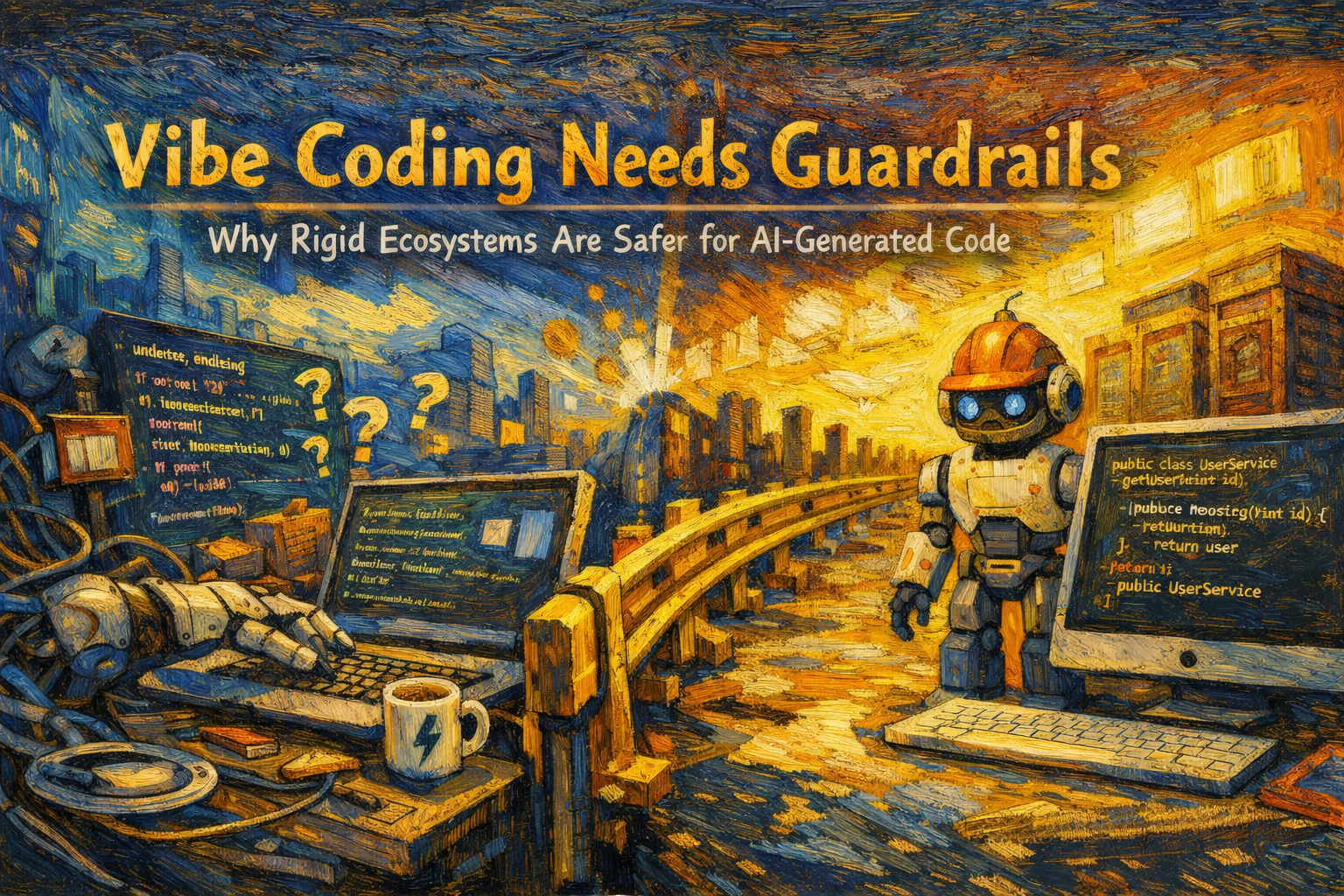
AI-assisted programming has quietly created a new development style: vibe coding.
You describe what you want.
The model produces code.
You skim it, maybe run it, tweak a few things, and keep moving.
Sometimes it’s astonishingly productive. A feature that might have taken an hour appears in seconds.
But vibe coding changes something fundamental about software development:
who is responsible for catching mistakes.
Traditionally, a careful developer wrote code deliberately, and the compiler helped catch errors.
With vibe coding, the loop often looks more like this:
- An AI generates code.
- A human quickly sanity-checks it.
- The system reveals what breaks.
In other words, you’re relying much more heavily on the environment — the language, the compiler, and the framework — to catch incorrect assumptions.
That’s where the design of your ecosystem suddenly matters a lot.
When the Author Is Guessing, the System Should Push Back
Experienced developers can work safely in flexible languages because they carry a large mental model of the system.
They know what patterns are acceptable.
They know where boundaries belong.
They recognize when something “looks wrong.”
Vibe coding changes that dynamic.
You are often accepting code that looks plausible before you fully understand it.
In that environment, the ideal system constantly asks:
“Are you sure you meant that?”
Languages and frameworks that enforce constraints do this well.
Languages and ecosystems that allow many implicit behaviors do not.
That’s why a stack built around Java and its surrounding ecosystem can often be safer for AI-assisted development than something more flexible like JavaScript.
Not because Java is “better.”
But because Java resists vague or incorrect ideas much earlier.
Flexible Languages Let Half-Right Ideas Survive
JavaScript’s design philosophy is extremely permissive.
This flexibility has been incredibly successful. It made the language accessible, adaptable, and capable of powering a massive ecosystem.
But permissive systems also allow many things to “sort of work.”
For example:
- loose type coercion
- dynamic object shapes
- runtime discovery of many errors
- multiple architectural styles in the same codebase
- many equally valid ways to structure the same feature
For experienced developers, this flexibility is powerful.
For AI-generated code, it can be risky.
AI systems are very good at generating code that looks correct but contains subtle logical mistakes.
Flexible environments often allow those mistakes to run without failing immediately.
The result is code that executes but behaves incorrectly — the most dangerous type of bug.
Java Forces Intent Into the Code
Java takes almost the opposite approach.
The language forces you to describe your program in explicit terms.
You must declare:
- types
- method signatures
- class structures
- interfaces
- explicit data shapes
Developers often complain that this feels verbose.
But when AI is generating code, that verbosity becomes extremely valuable.
The language forces assumptions to become visible.
If the model guesses incorrectly about the shape of data or the behavior of a method, the compiler usually rejects the code immediately.
That feedback loop is exactly what vibe coding needs.
Instead of letting questionable ideas run, the system stops them early.
The Database Boundary Is Where Many AI Bugs Appear
Another place where rigid ecosystems help is at the database boundary.
AI-generated code frequently struggles with:
- schema mismatches
- inconsistent object shapes
- incorrect assumptions about relationships
- null handling
- query construction
- migration drift
These are not simply coding mistakes. They are data modeling mistakes.
The Java ecosystem has spent decades building standardized ways to model persistence.
Technologies like Java Database Connectivity, Hibernate, and the Java Persistence API encourage developers to represent database structures explicitly in code.
Frameworks like Spring Boot further reinforce these patterns by providing conventions around repositories, entities, and transactions.
The result is that data models become visible and structured inside the codebase.
When an AI generates code in that environment, it has clear boundaries to follow.
Without those constraints, models often invent fields, relationships, or queries that don’t match the underlying schema.
Frameworks That Enforce Architecture Provide Another Layer of Safety
The safety of rigid ecosystems doesn’t come from typing alone.
It also comes from frameworks that impose architectural structure.
A typical Java application built with a framework like Spring Boot often follows recognizable layers:
Controller
Service
Repository
Entity
These layers create clear boundaries:
- controllers handle HTTP requests
- services contain business logic
- repositories interact with persistence
- entities represent data structures
Because these patterns are widely shared, deviations are easy to spot.
If AI-generated code places business logic in the wrong layer or mixes concerns, it becomes obvious.
Flexible ecosystems often leave architectural decisions entirely up to the developer. That freedom is powerful, but it can also allow architectural drift when code is generated rapidly.
Rigid frameworks act like rails that keep the system aligned.
Constraints Help AI Stay Grounded
AI systems perform best when the surrounding environment contains clear signals about what correct code looks like.
Rigid ecosystems provide many of those signals:
- explicit types
- standardized persistence patterns
- consistent architectural conventions
- predictable project structures
These constraints act as guardrails.
If the model produces something inconsistent with the rest of the system, the error appears quickly.
In looser environments, those inconsistencies can remain hidden until much later.
A Helpful Metaphor
Imagine two workshops.
One is filled with powerful tools, adapters, extension cords, and duct tape. An expert craftsperson can build almost anything there.
The other workshop has jigs, guards, rails, and calibrated fixtures. It’s harder to improvise, but mistakes get caught quickly.
An experienced builder can succeed in either space.
But if you’re building by vibe, you are much safer in the workshop with guardrails.
This Doesn’t Mean Rigid Ecosystems Are Always Better
Flexible languages are fantastic for experimentation.
For quick prototypes or disposable tools, minimal structure can accelerate progress.
But if the software might:
- reach production
- be maintained long-term
- become part of a larger system
- be extended by other developers
then the tradeoffs change.
In AI-assisted development, environments that push back on incorrect assumptions become extremely valuable.
The Real Lesson
The rise of AI coding tools is forcing developers to reconsider something important:
Programming languages and frameworks are not just tools for humans anymore.
They are also the environment in which AI generates ideas.
When part of the development process involves guesswork and pattern synthesis, the system surrounding the code becomes responsible for catching mistakes early.
Rigid ecosystems — with strong typing, explicit data modeling, and enforced architecture — provide those safeguards naturally.
They say “no” sooner.
And when you’re vibe coding, that’s exactly what you want.
Leave a Reply