You hover your inspector over a tiny icon. You see background-position: -832px -47px. You blink. You scroll to the top of the stylesheet and find a single PNG weighing 4.2 megabytes. You close the inspector and never speak of it again.
To the young web developer: you will never know this pain. Nor this beauty.
Today, we gather not to mourn a technology—technologies die every day. We gather to mourn a relationship. A strange, codependent, pixel-perfect, deeply unhinged relationship between a developer, a grid of tiny images, and a browser that absolutely refused to play nice.
CSS Sprites did not ask to be born. They were forged in the fires of dial-up modems and IE6, in a time when an HTTP request cost you seconds of your user’s life, and a single extra round-trip to the server could tank your bounce rate like a stone.
And in that crucible, we did something beautiful.
We took thirty icons—home, search, cart, mail, profile, settings, logout, and twenty-three others you’d forgotten existed—and we stitched them together. Like a digital quilt. Like a mad scientist’s scrapbook. We opened Photoshop, we set the grid to 16×16, and we built The Sheet.
It was ugly. It was chaotic. It looked like a QR code had a baby with a toolbar from 1998.
And we loved it.
The Ritual
Let me describe the ritual to you, because you won’t read it in any modern framework’s documentation.
Step 1: You saved every icon as a separate .gif or .png.
Step 2: You opened Photoshop and manually arranged them into a grid, leaving exactly 2 pixels of breathing room between each one so they wouldn’t bleed into each other.
Step 3: You exported sprites.png.
Step 4: You opened your CSS and wrote something that looked like a demonic incantation:
.icon-home {
  width: 16px;
  height: 16px;
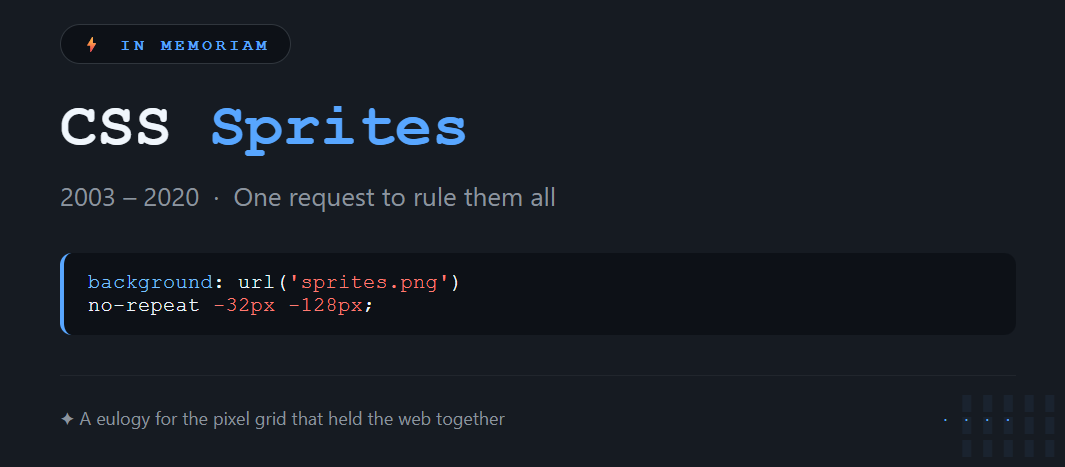
  background: url('sprites.png') no-repeat -32px -128px;
}
Step 5: You saved, refreshed, and… it was wrong. Off by one pixel. Always off by one pixel.
You went back to Photoshop. You measured. You counted. You swore. You adjusted -32px to -33px. You refreshed. Perfect.
You repeated this for forty-seven more icons.
And when you finished, you looked at your work—thirty lines of CSS, one HTTP request, zero compromises—and you felt something rare: the satisfaction of having hacked the system. The browser wanted to be slow. You said no.
The Golden Age
There was a brief, shining window—roughly 2008 to 2014—when CSS Sprites were not just a technique, but a badge of honor.
- If you were a junior dev, you learned sprites in your first month.
- If you were a senior dev, you automated them with tools like Compass, Spritely, and Grunt. You’d point them at a folder of images and they’d stitch everything together and generate the CSS for you. It felt like magic.
- If you were a legend, you built your sprite sheets by hand and you remembered every coordinate. You were the keeper of the map. The team came to you when an icon needed shifting, and you’d mutter “oh, that’s at row 4, column 7” like a wizard reading tea leaves.
And the browser? The browser loved you for it. One file. One cache hit. When users navigated to page two, page three, page four—instant. No loading spinners. No flash of white. Just pure, unadulterated speed.
We didn’t have service workers. We didn’t have HTTP/2 multiplexing. We had a rectangle of pixels and sheer, stubborn will.
The Slow Goodbye
HTTP/2 arrived in earnest around 2015. Multiplexing made multiple requests cheap. Server push made preloading trivial. The economic argument for sprites—the only argument, really—crumbled like a dry cookie.
And then came responsive design. Retina displays. Viewport units. Art direction.
Suddenly, a single 4MB sprite sheet was a liability, not a win. You couldn’t serve 1x icons to phones and 2x icons to desktops. You couldn’t lazy-load just the icons you needed. You couldn’t swap out a single icon without invalidating the entire cache and making every user re-download the whole sheet.
SVG sprites stepped in—cleaner, scalable, more elegant. Icon fonts danced in their wake. And eventually, even those gave way to individual .svg files loaded on-demand, because modern browsers had finally grown up and learned to handle 50 requests without breaking a sweat.
CSS Sprites didn’t die with a bang. They didn’t deprecate. They just… stopped being written.
One day, you opened a new project, and no one said “let’s use sprites.” You opened an old project, and you gently refactored them out. You closed the PR. You moved on.
And somewhere, in a dusty CDN bucket, a sprites.png from 2012 still sits, unrequested, unloved, perfectly cached for a user who will never visit again.
What They Taught Us
So why do we mourn?
Because CSS Sprites were never just about performance. They were about resourcefulness. They were about staring at a limitation—browsers can only open 2 connections at a time—and deciding to outsmart it rather than accept it.
They taught us to think in round-trips, not kilobytes.
They taught us that caching is a strategy, not a feature.
They taught us that every pixel counts, and that sometimes the ugliest solution—a chaotic grid of mismatched icons—is actually the most brilliant one.
In an era of npm install and 300-megabyte node_modules, we could all stand to remember what it felt like to squeeze every ounce of performance out of a single PNG. To measure twice, code once, and take pride in the craft.
Rest in Pixels
So here’s to you, CSS Sprites.
- To the
background-positionthat never quite lined up. - To the Photoshop guides that kept us sane.
- To the moment we discovered
background-size: coverand wept. - To the commit messages that said “updated sprite sheet” and changed 3,000 lines of CSS.
You were not elegant. You were not accessible. You were a nightmare to maintain.
But you worked.
And in a world of half-baked frameworks and bloated bundles, that counts for something.
2003 – 2020
“One request to rule them all.”
If you’re a new developer reading this, and you’ve never written background-position with negative numbers by hand—cherish that ignorance. But also, open your dev tools some day. Find an old site. Look for a single, massive PNG filled with tiny icons. Zoom in. Marvel.
That was us. That was our art.
And it was enough.
Leave a Reply