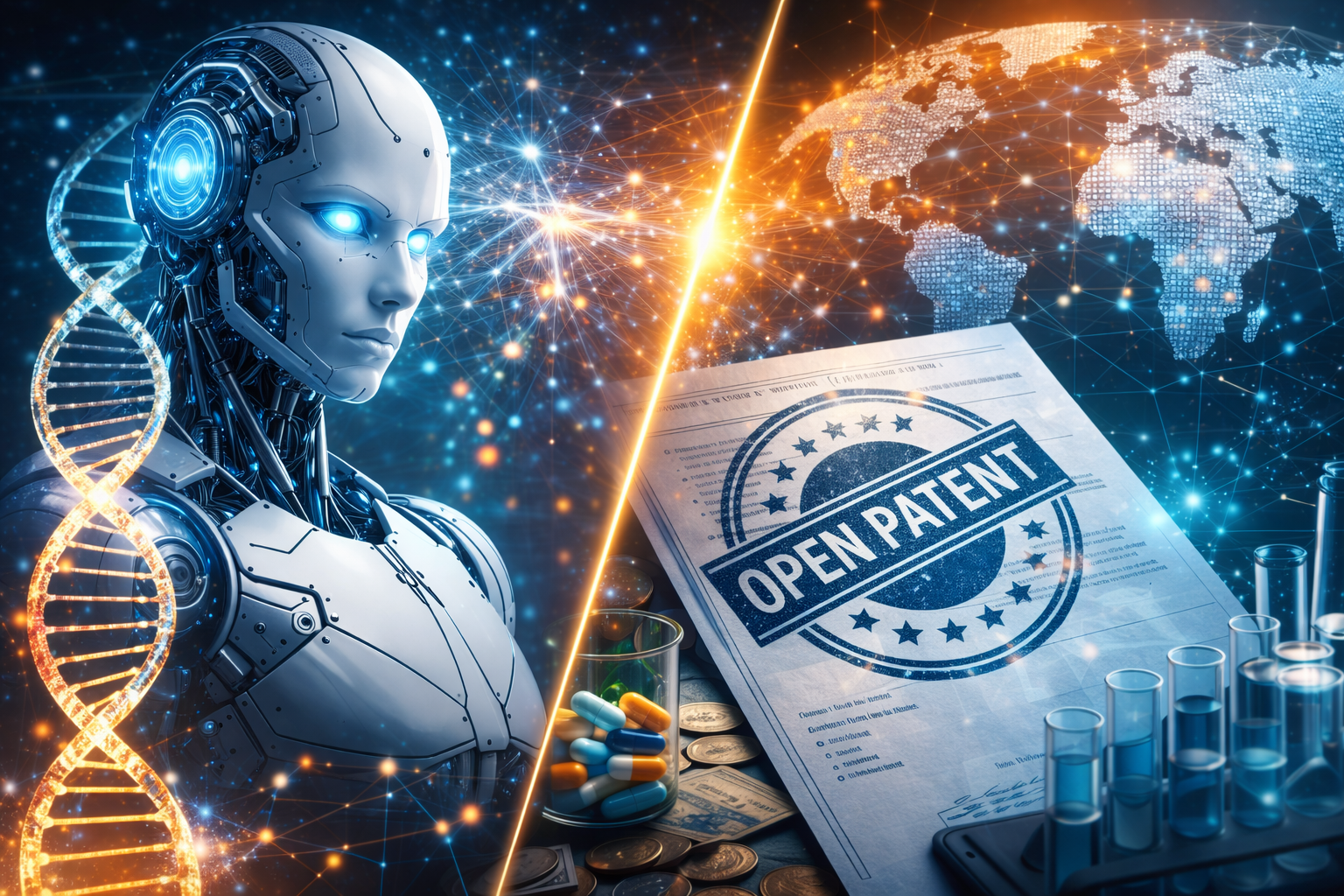
There’s an uncomfortable idea I can’t shake:
What if the only way to keep the future of medicine open… is to grab it first?
That sounds aggressive—because it is. But it might also be necessary.
The Problem: Innovation Gets Locked Up
Modern medicine doesn’t just run on science—it runs on intellectual property.
When a company discovers a promising drug, they don’t just patent the molecule. They patent:
- Variations of it
- Methods of production
- Delivery mechanisms
- Entire classes of related compounds
The result is something called a patent thicket—a dense web of overlapping claims that makes it legally risky for anyone else to operate in that space.
This isn’t hypothetical. It’s standard practice.
And it creates a real tension:
- We want innovation rewarded
- But we also want lifesaving treatments widely accessible
Right now, the system often tilts toward control.
A New Tool Changes the Equation
Artificial intelligence introduces something radically new:
The ability to explore massive scientific possibility spaces—fast.
AI can:
- Generate thousands of plausible drug candidates
- Suggest chemical variants and analogs
- Map out entire therapeutic pathways
- Identify unexplored gaps in existing patents
In other words, AI doesn’t just discover one idea—it can sketch out the entire neighborhood around it.
That changes the strategy.
The Land Grab Idea (But Flipped)
Here’s the core idea:
Use AI to aggressively map and claim future drug spaces—not to own them, but to prevent anyone else from locking them down.
Call it a public-interest land grab.
Instead of:
- Waiting for companies to patent narrow discoveries
You:
- Preemptively cover broad areas of possibility
- Then make those claims permanently open
It’s offensive action in service of openness.
How This Could Work
There are two primary mechanisms:
1. Defensive publication (no patents at all)
You:
- Generate drug candidates and methods using AI
- Publish them publicly with timestamps
Result:
- They become prior art
- No one else can patent them later
This is the cleanest way to keep a space open.
2. Open patents with irrevocable licensing
You:
- File patents on AI-generated discoveries
- Attach permanent, royalty-free licenses for everyone
Result:
- The ideas are protected from monopolization
- But freely usable by researchers, companies, and the public
Think of it like open-source software—but for medicine.
Why This Might Be Necessary
If you don’t do this, someone else will.
AI doesn’t just empower individuals. It supercharges:
- pharmaceutical companies
- well-funded startups
- state-backed research programs
They will use AI to:
- expand patent coverage faster
- lock down broader areas
- move earlier in the discovery pipeline
So the real risk isn’t AI itself.
It’s AI combined with exclusive control.
The Parallel to Other Powerful Tools
There’s a broader principle here:
Powerful tools don’t just create risk—they create asymmetry.
If only a few actors have access, they dominate.
If access is widespread, power balances out.
With AI, the question becomes:
- Do we let it concentrate control over future medicine?
- Or do we use it to distribute that control as widely as possible?
This “land grab for the commons” is one answer.
The Catch (Because There’s Always One)
This strategy only works if you’re disciplined about one thing:
You cannot keep control.
The moment you:
- restrict access
- require permission
- or centralize decision-making
You’ve recreated the same problem you were trying to solve.
Worse—you’ve accelerated it.
Because now you’re not just one actor with patents.
You’re an actor with AI-amplified patents.
The Real Risk: An AI Patent Arms Race
Let’s be honest about where this could go wrong.
If multiple groups adopt this mindset, we could see:
- massive volumes of AI-generated patent filings
- entire fields claimed preemptively
- legal systems overwhelmed by synthetic IP
At best, that creates noise.
At worst, it creates a new kind of enclosure—just faster and more chaotic.
So the goal isn’t just speed.
It’s intentional openness at scale.
A More Radical Vision
Imagine a global, open database where:
- AI continuously generates drug candidates
- Everything is immediately published or openly licensed
- Researchers anywhere can build on it
- No single entity can lock it away
That would:
- lower barriers to entry
- accelerate discovery
- shift competition from ownership → execution
Instead of:
“Who owns the idea?”
We get:
“Who can turn it into a real treatment fastest?”
That’s a healthier competition.
Final Thought
We’re entering a world where ideas—especially scientific ones—can be generated faster than ever before.
That creates a choice.
We can:
- let AI accelerate the privatization of knowledge
Or:
- use AI to flood the zone with openness before it can be enclosed
It’s a strange strategy.
It feels like aggression.
But it might be the only way to ensure that the most important breakthroughs of the future… actually belong to everyone.
Leave a Reply