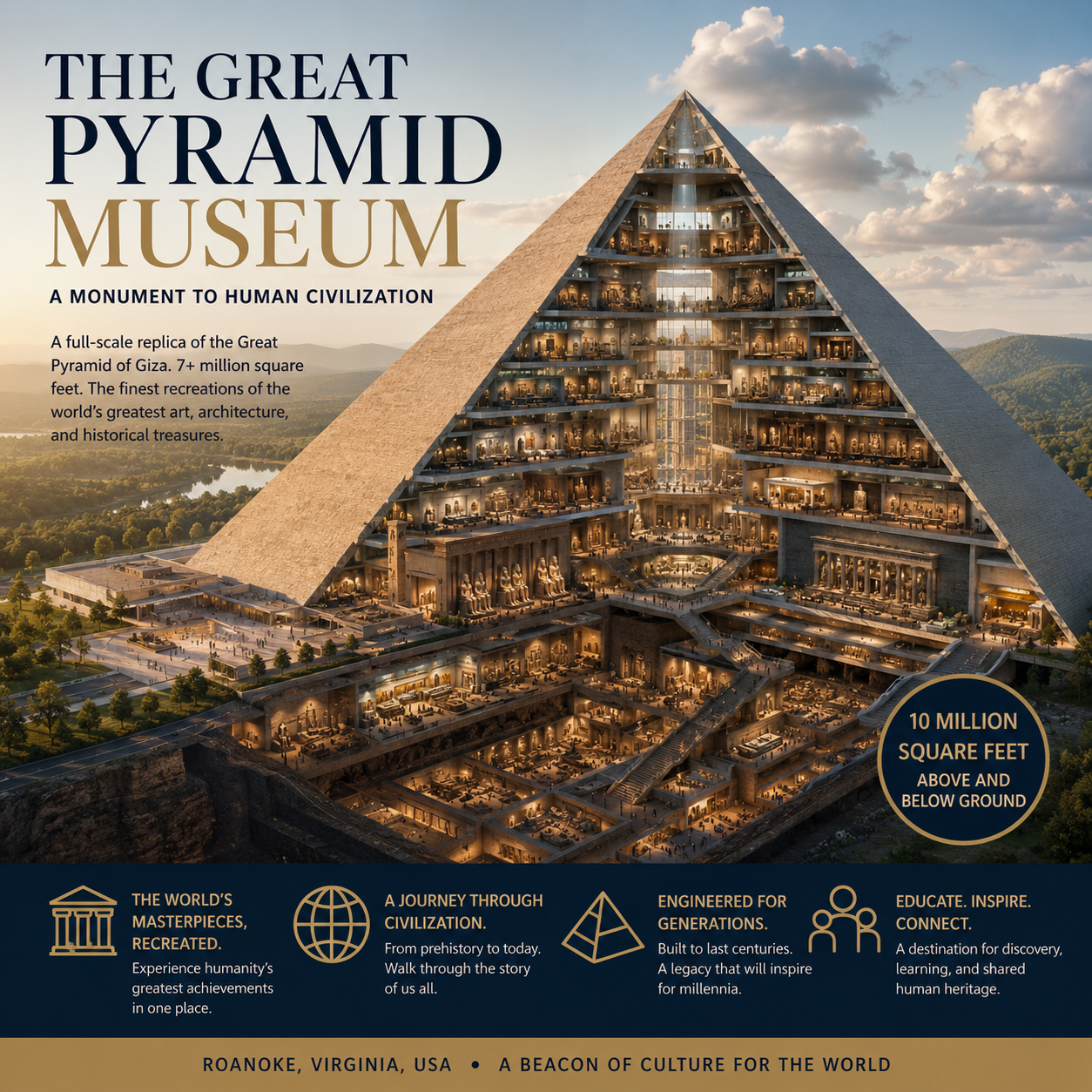
A Monument to Human Civilization
There are very few opportunities left to build something that could still matter a thousand years from now.
This is one of them.
The proposal is simple to describe and almost impossible to forget:
Build a full-scale replica of the Great Pyramid of Giza, hollow on the inside, and turn it into the greatest museum of human civilization ever created.
Not a conventional museum. Not a collection of originals locked behind glass. A new category entirely: the finest physical reproductions of the world’s greatest art, architecture, artifacts, spaces, and cultural achievements, recreated with the best technology and scholarship money can buy.
The Great Pyramid is the right vessel because the building itself immediately communicates scale, permanence, ambition, and civilization. At approximately 756 feet on each side and originally 481 feet tall, a full-scale replica could contain several million square feet of interior space while preserving immense central voids, galleries, ramps, atriums, and monumental chambers.
It would be one of the largest cultural institutions on Earth.
The Idea
Imagine walking into the pyramid and beginning a journey through human history.
You enter prehistory: cave art, early tools, reconstructed settlements, the first ritual spaces.
You move into Egypt, Mesopotamia, Greece, Rome, India, China, Mesoamerica, Africa, and the great civilizations of the ancient world.
You walk through architectural spaces recreated at full scale or near-full scale. You see sculpture not merely as it survives today, but also as scholars believe it originally appeared. You encounter paintings in extraordinary fidelity, historical rooms reconstructed from laser scans, manuscripts enlarged and interpreted, lost works recreated from surviving evidence, and monumental structures displayed in ways no conventional museum could accommodate.
The visitor does not merely look at civilization.
The visitor walks through it.
Why Replicas Are the Advantage
Traditional museums are limited by scarcity.
The Mona Lisa can only be in one place. The Parthenon cannot travel. Fragile manuscripts cannot be handled. Ancient temples cannot be reassembled every time scholarship changes. Paintings must often be viewed from behind barriers, under conservation lighting, surrounded by crowds.
This museum would have different rules.
Every object would be openly identified as a reproduction. The goal would not be to imitate ownership of the original. The goal would be to create the best possible encounter with the work.
A Michelangelo sculpture could be reproduced from sub-millimeter scans.
A Roman statue could be shown both as it survives today and reconstructed with its original pigments.
Visitors could walk through a recreated Egyptian tomb without damaging a 3,000-year-old surface.
The Sistine Chapel ceiling could be presented at its original architectural scale and, elsewhere, reproduced close enough to the floor that visitors could study details normally 60 feet overhead.
The caves at Lascaux could be experienced without threatening the originals.
Destroyed works and buildings could be reconstructed from photographs, scans, archaeological evidence, and historical documentation.
In many cases, the visitor experience could actually be more educational than standing in front of the original.
A Museum That Real Museums Cannot Build
The Great Pyramid Museum could contain things that no existing museum can assemble under one roof:
- The great masterpieces of painting from dozens of countries.
- Full-scale architectural reconstructions.
- Ancient monuments restored virtually and physically to their original appearance.
- Historic interiors and archaeological sites.
- Great manuscripts, maps, scientific instruments, and engineering achievements.
- Music, theater, and cultural environments integrated into the galleries.
- Lost and destroyed works recreated from the best surviving evidence.
- Interactive exhibits showing how scholarship changes our understanding of the past.
The museum could also commission multiple interpretations where historians disagree.
Visitors might see a classical temple as it exists today, then step into a reconstruction showing what current scholarship believes it looked like 2,400 years ago.
Instead of hiding uncertainty, the museum could make discovery part of the experience.
The Architecture
The interior should not simply be divided into ordinary floors.
That would waste the opportunity.
A significant portion of the pyramid should remain open as monumental interior space: a central atrium perhaps hundreds of feet high, crossed by bridges, terraces, elevators, ramps, and gallery structures.
Imagine entering a vast interior canyon carved into the pyramid, with civilizations rising around you.
Some galleries could occupy conventional museum floors. Others could be enormous spaces capable of housing temples, monumental sculpture, ships, architecture, and immersive environments.
The geometry of the pyramid naturally creates smaller spaces toward the top. That lends itself beautifully to chronology or thematic progression.
The building itself becomes part of the narrative.
The Visitor Experience
A visitor should be able to spend three hours, three days, or three weeks inside.
There could be multiple routes:
The Human Story — a chronological journey from prehistory to the present.
The Masterpieces — several hundred of humanity’s most important works.
Civilizations — deep explorations of particular cultures and eras.
Architecture — reconstructed spaces and buildings.
Ideas That Changed the World — writing, mathematics, religion, science, political thought, technology, and invention.
Lost Civilization — destroyed, inaccessible, or vanished cultural treasures reconstructed through technology.
A visitor could stand in ancient Egypt in the morning, Renaissance Florence at lunch, Mughal India in the afternoon, and Belle Époque Paris before dinner.
No institution on Earth currently offers that experience.
Technology Makes This Possible Now
Twenty years ago, this project would have depended heavily on artistic interpretation.
Today we have photogrammetry, lidar, volumetric scanning, hyperspectral imaging, robotic fabrication, CNC stonework, large-format additive manufacturing, advanced materials, computational archaeology, digital twins, and extraordinarily high-resolution imaging.
Museums and universities around the world are already digitizing their collections.
The Great Pyramid Museum could become the institution that turns that digital heritage back into physical experience.
It could also establish partnerships with the institutions that hold the originals. Rather than competing with the Louvre, the Met, the British Museum, the Vatican Museums, or national collections, it could direct visitors toward them and pay licensing, scanning, scholarship, and collaboration fees.
The originals remain priceless.
This museum makes their significance accessible.
Why a Pyramid?
Because nobody remembers the world’s fiftieth-largest museum building.
They would remember this.
The Great Pyramid is arguably the most recognizable monument ever built. A full-scale modern counterpart would instantly become one of the world’s most recognizable destinations. The Great Pyramid was the tallest building in the world for over 3000 years — a record unlikely to be broken.
The building provides its own brand.
You would not need to explain it in an advertisement.
A photograph would do the job.
And unlike a novelty replica, the exterior form would serve a serious purpose: it would house an institution devoted to the very thing the pyramids symbolize — humanity’s desire to leave something behind.
Economic Potential
This could be a global destination rather than simply a museum.
The complex could include hotels, restaurants, performance spaces, research institutions, educational facilities, conservation laboratories, fabrication workshops, conference facilities, and rotating exhibitions.
It could support:
- International tourism
- School programs
- University partnerships
- Research fellowships
- Licensing and media production
- Documentary and educational content
- Corporate events
- Cultural festivals
- Traveling exhibits
- Digital memberships and virtual access
A museum of this scale could justify repeat visits because only a fraction of the collection could realistically be experienced in one trip.
The objective need not be maximum profit.
The objective could be long-term financial self-sufficiency.
The Philanthropic Opportunity
A billionaire can fund a hospital wing, a university building, or an art collection.
Those are worthwhile things.
But very few people ever have the opportunity to create an institution that becomes part of civilization itself.
Andrew Carnegie built libraries.
John D. Rockefeller helped build major universities and cultural institutions.
J. Paul Getty created a museum whose name will survive him.
The Medicis helped create Florence.
The great patrons of history are remembered not simply because they accumulated wealth, but because at some point they converted wealth into civilization.
This project offers that opportunity at extraordinary scale.
The Standard
The project succeeds only if it refuses to become kitsch.
It cannot be a theme park wearing a museum costume.
Every reproduction should be held to an extraordinary standard of fidelity. Every reconstruction should identify its evidence. Every gallery should involve serious historians, scientists, artists, conservators, archaeologists, engineers, and cultural institutions.
Accuracy should become part of the brand.
The promise to the visitor should be:
If humanity knows how this looked, we will show you. If humanity is uncertain, we will show you that too.
The Legacy
There is one final reason to build it.
Most modern buildings are designed with a lifespan measured in decades.
This one should be designed with a lifespan measured in centuries.
The exterior could use stone, concrete, and modern structural systems engineered for extreme durability. Interior galleries could evolve continuously while the monumental shell remains.
Future generations could add discoveries we cannot anticipate.
New archaeological finds.
New scanning technologies.
New reconstructions.
New art.
New interpretations of history.
The museum would never truly be finished because civilization is not finished.
That is the point.
The ancient Egyptians built a structure that has survived roughly 4,500 years.
The ambition here should be equally audacious:
Build something worthy of being visited in the year 2500.
Not a monument to one person.
Not a monument to one country.
A monument to what human beings have created.
The Great Pyramid Museum of Human Civilization.
Leave a Reply