
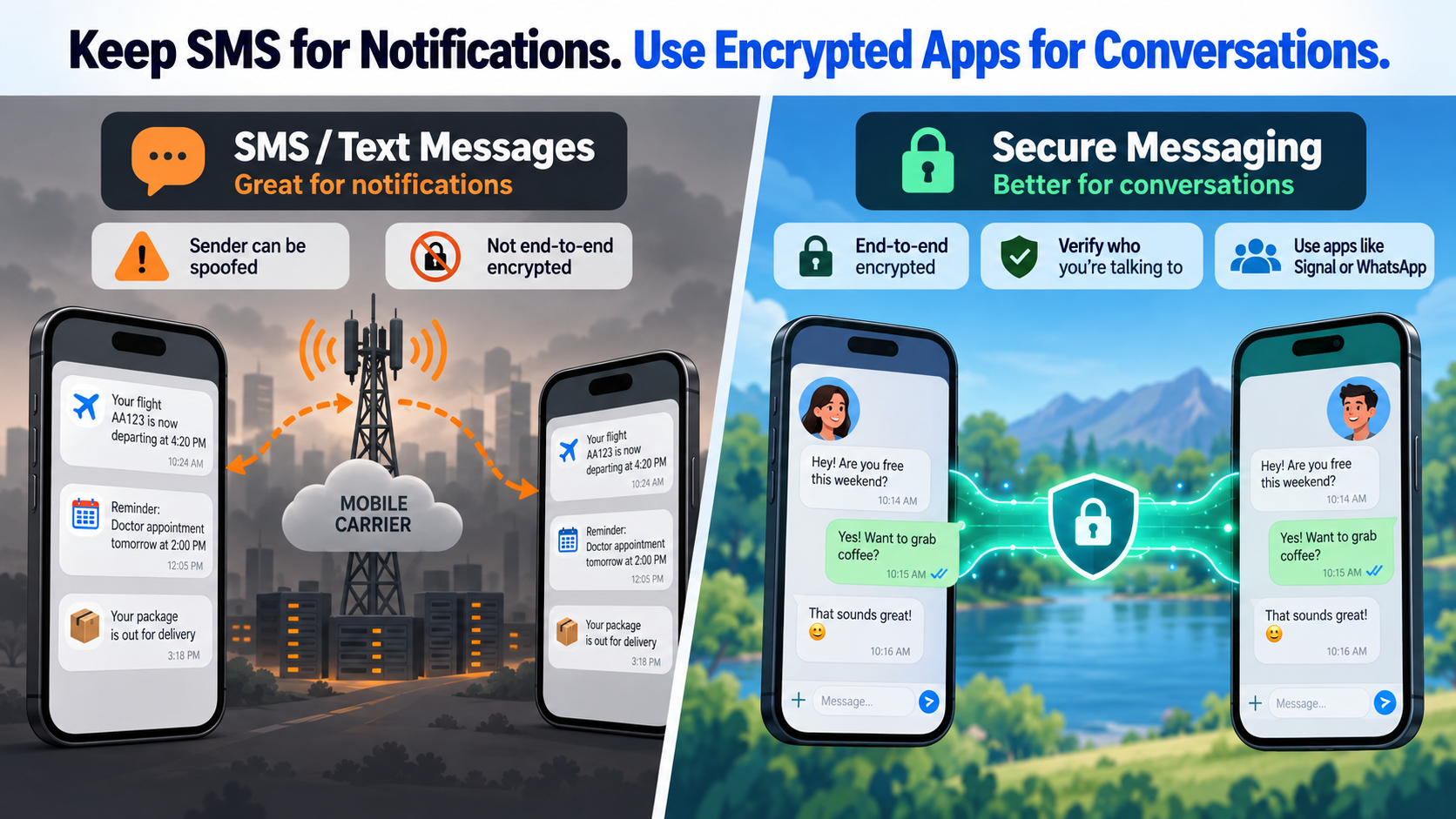
SMS is great for flight notifications, appointment reminders, and delivery updates. But for conversations with friends and family, it’s time to move on.
I love text messaging. It’s one of those technologies that works so well we’ve almost forgotten how remarkable it is.
Your airline can tell you your flight is delayed. Your doctor’s office can remind you about tomorrow’s appointment. Amazon can notify you that your package has arrived.
And it all works without installing another app.
SMS (Short Message Service) is nearly universal. Almost every mobile phone supports it, and it generally works regardless of which carrier or type of phone you use.
But there’s a problem.
SMS was never designed to be a secure, private communications system. And in 2026, there’s no good reason to keep using it for personal conversations when much better alternatives are free.
That Text From Your Friend Might Not Be From Your Friend
When your phone receives a traditional SMS message, it displays the telephone number of the sender.
Naturally, you assume that the message actually came from that number.
That’s not always a safe assumption.
SMS sender information can be spoofed. Under certain circumstances, someone can send a message that appears to have come from a telephone number they don’t own.
This doesn’t necessarily require hacking the sender’s phone or stealing their SIM card. Some telecommunications gateways and international messaging routes permit manipulation of the sender information.
Now, there are important caveats. American carriers have implemented restrictions to make this more difficult, and reputable messaging services generally won’t let you send messages using arbitrary telephone numbers.
But the fundamental problem remains:
A telephone number appearing on an SMS message is not cryptographic proof of who sent it.
Imagine receiving this text from your brother:
“Hey, I’m in a little trouble. Can you send me $500? I’ll explain later.”
Your phone displays his name. The message appears in the same conversation where you’ve exchanged hundreds of messages over the years.
Would you question it?
You should.
The displayed number isn’t sufficient proof of identity.
Your Text Messages Aren’t Private, Either
Sender spoofing is only half the problem.
Traditional SMS messages are not end-to-end encrypted.
That means SMS doesn’t provide the kind of encryption that guarantees only the sender and recipient can read the message.
Your cellular carrier’s systems process and deliver the message. Other telecommunications providers may also be involved, particularly with international messages.
While portions of the transmission may be encrypted, the underlying SMS system does not provide end-to-end encryption.
That creates opportunities for interception, unauthorized access, and disclosure.
Think about the things people routinely send over SMS:
- Personal conversations with spouses and friends
- Addresses and travel plans
- Financial information
- Private photographs
- Passwords and authentication codes
- Sensitive family information
None of this belongs on a communications system that lacks modern end-to-end security.
The issue isn’t that somebody is necessarily reading your messages. It’s that the technology doesn’t provide adequate protection against the possibility.
So Why Is SMS Still Useful?
Because not every communication needs to be confidential or interactive.
Consider these messages:
“Your flight AA1234 is now boarding at Gate 17.”
“Reminder: Your dental appointment is tomorrow at 10:30 AM.”
“Your package has been delivered.”
SMS is extremely useful for this kind of notification.
It’s simple, widely supported, and doesn’t require the recipient to install an application or create an account.
That’s a terrific combination for businesses trying to reach customers.
Of course, even these messages can be spoofed, so don’t blindly trust links or instructions contained in them. And sensitive medical or financial details should not be included in ordinary SMS notifications.
But as a way to deliver routine information, SMS still has an important role.
The problem isn’t SMS itself. The problem is using SMS for something it was never designed to do: provide secure, authenticated, private conversations.
What About iMessage and RCS?
Modern phones have made this a little confusing.
If you have an iPhone, you may have noticed that some messages appear in blue bubbles and others in green.
Blue-bubble iMessages between Apple users support end-to-end encryption. They aren’t traditional SMS messages.
Likewise, RCS (Rich Communication Services), the modern replacement for SMS, can support end-to-end encryption, depending on the applications and devices involved.
That’s progress.
But it also means you can’t assume every message sent through your phone’s default messaging application enjoys the same security protections.
Some conversations may be encrypted. Others may fall back to SMS or MMS.
I prefer a simpler solution: use a messaging application where end-to-end encryption is the default for personal conversations.
Two Free Alternatives: Signal and WhatsApp
You don’t need to understand encryption to use secure messaging. You just need to install an application designed for it.
Two excellent choices are Signal and WhatsApp.
Signal: My First Recommendation
Signal is a nonprofit-operated messaging application designed around privacy.
It offers:
- End-to-end encrypted text messages
- Encrypted voice and video calls
- Group conversations
- Photos, videos, and file sharing
- Disappearing messages
- Support for iPhone, Android, and desktop computers
Signal’s encryption is always enabled. You don’t need to find a security setting or remember to turn it on.
Signal is also open source, meaning its software can be examined by independent security researchers.
Importantly, Signal is designed to collect and retain very little information about its users.
If privacy is your primary concern, Signal is my recommendation.
WhatsApp: An Excellent Alternative
WhatsApp offers many of the same capabilities:
- End-to-end encrypted personal messages
- Voice and video calling
- Group conversations
- File and photo sharing
- Support for iPhone, Android, and desktop computers
WhatsApp uses the Signal encryption protocol to secure ordinary personal messages.
Its biggest practical advantage is its enormous user base. There’s a reasonable chance many of your friends and relatives already use it.
There is one important distinction: WhatsApp is owned by Meta, the company behind Facebook and Instagram. Although personal messages are end-to-end encrypted, WhatsApp’s broader collection and handling of account and usage information differs from Signal’s privacy-focused approach. Business conversations can also have different protections.
Still, for ordinary personal communication, WhatsApp is a substantial security improvement over traditional SMS.
Encryption Isn’t Magic
There’s one point worth emphasizing.
End-to-end encryption protects the contents of your communications while they’re being transmitted and handled by the messaging service.
It doesn’t make fraud impossible.
Someone can still create a fake account, impersonate a friend, steal an unlocked phone, compromise an account, or trick you into revealing information.
For important conversations, Signal and WhatsApp both offer mechanisms to help verify the identity of the person you’re communicating with.
And if someone unexpectedly asks you to transfer money, reveal a password, or disclose an authentication code, verify the request independently, regardless of which messaging application you’re using.
Security depends on both technology and good judgment.
It’s Time to Change Our Habits
SMS has had a remarkable run.
Introduced more than three decades ago, it became one of the world’s most successful communications technologies.
And it’s not going away anytime soon.
Airlines, delivery companies, appointment systems, and countless other businesses will continue using it because it’s a practical way to reach almost everybody.
That’s fine.
But when I’m communicating with my friends or family, I want to know two things:
- That the conversation is private.
- That I have a reliable way to verify the person I’m talking to.
Traditional SMS doesn’t adequately provide either assurance.
Signal and WhatsApp offer end-to-end encryption and identity-verification features that SMS simply lacks.
So here’s my recommendation:
Keep SMS for notifications. Use Signal or WhatsApp for conversations.
Both are free. Both are easy to install. Both work across iPhone and Android.
And the next time you text a friend, consider sending one last SMS:
“Hey, let’s move this conversation to Signal.”
Because in 2026, we really should know better.
Leave a Reply