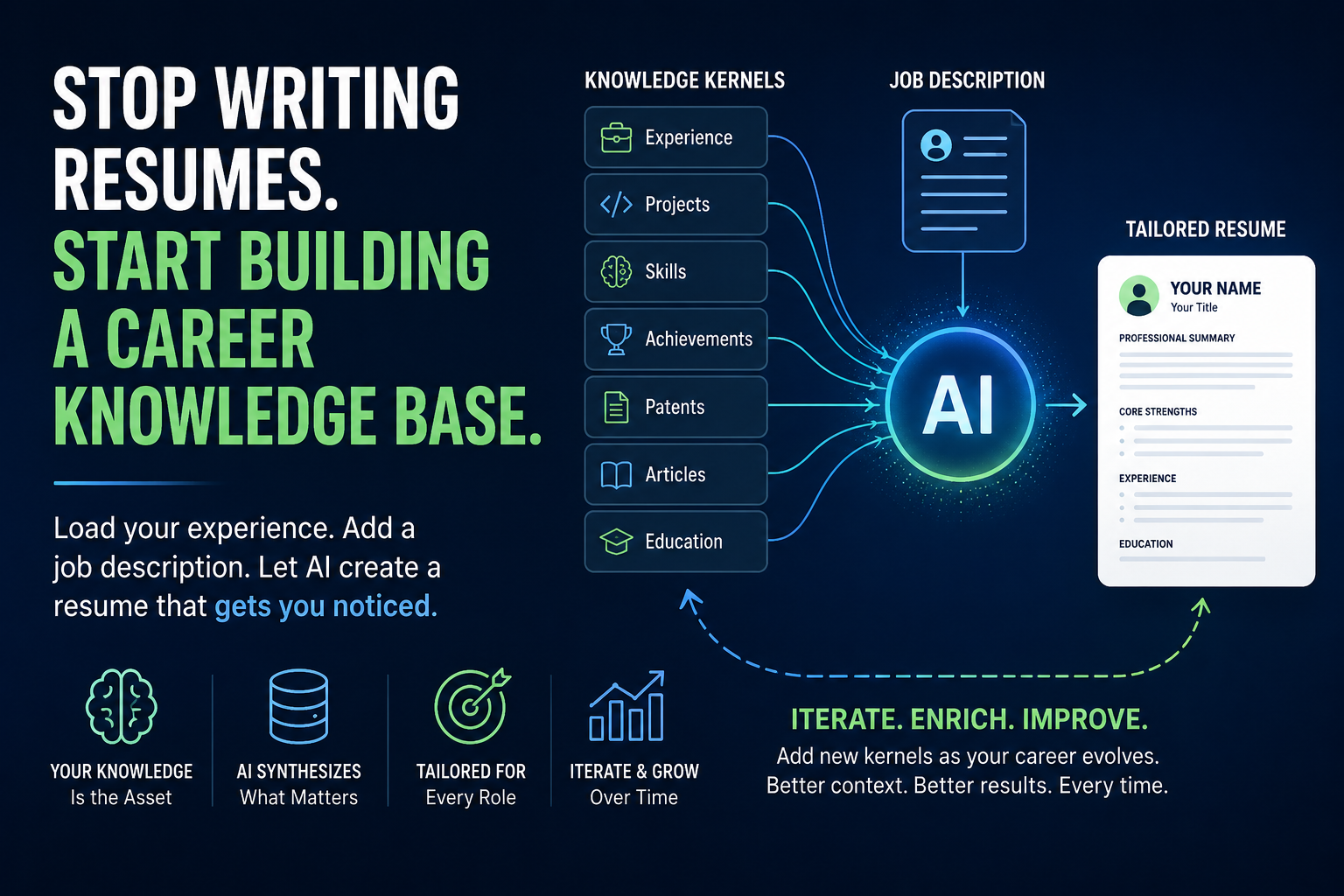
Every time I help someone apply for a job, I see them doing the same thing to begin: opening up a Word document and manually editing a resume to match the position.
That process made sense in 2005. It doesn’t make much sense in the age of AI.
The Resume Is Not the Asset
Most professionals think their resume is the important artifact. It isn’t.
The valuable asset is the collection of experiences, accomplishments, projects, skills, patents, articles, presentations, certifications, and stories accumulated over a career. The resume is simply a generated view of that information.
Once you understand that distinction, the process changes completely. Instead of maintaining one giant resume, I maintain a collection of small “knowledge kernels.”
A kernel might be:
- A specific job experience
- A project description
- A patent
- An article I wrote
- A technical skill
- An accomplishment
- An educational credential
- A leadership experience
Each kernel lives in its own file.
For example:
experience_palm.md
experience_esped.md
experience_reelreport.md
skills.md
education.md
patents.md
publications.md
Each file contains only the facts relevant to that topic. I store them in md (Markdown format) because as an engineer that’s how I document things, and it’s easily parsed by AI. But you could user word docs or even plain text. AI will format for you. It just needs the facts
Together they form a structured representation of my professional history.
AI Is Excellent At Synthesis
Once these kernels exist, the process becomes straightforward.
Load the kernels into an AI model.
Then load the job description.
Ask:
“Using only the information contained in these kernels, create a two-page resume optimized for this position.”
The AI is no longer inventing content. It is selecting, prioritizing, and organizing information. That’s a much safer and more effective use of AI.
For a healthcare AI platform role, the model may emphasize:
- Agentic AI
- Governance
- Validation frameworks
- Healthcare experience
- Reliability engineering
For a cloud architecture role, the same source material might emphasize:
- AWS
- Infrastructure
- Distributed systems
- Scalability
- Cost optimization
The underlying experience hasn’t changed.
Only the presentation has.
The Secret Advantage: Iteration
The real power appears over time.
Most resumes are static documents.
A knowledge base is a living system.
Every time you complete a project, write an article or blog, receive a patent, speak at a conference, or learn a new technology, you add another kernel.
The next time you generate a resume, that new information automatically becomes available.
Over time your knowledge base grows richer.
The AI gains more raw material.
The generated resumes become more accurate and more persuasive.
Instead of editing one resume hundreds of times, you’re continuously improving the source material.
This is exactly the same principle that software engineers use when maintaining source code instead of editing compiled binaries.
The Career Operating System
I’ve started thinking of this as a personal career operating system.
The kernels become the database.
The AI becomes the query engine.
The resume becomes one possible output.
But it doesn’t stop there.
The same knowledge base can generate:
- Cover letters
- Interview preparation notes
- Professional biographies
- LinkedIn summaries
- Conference speaker abstracts
- Grant applications
- Consulting proposals
- Annual performance reviews
Once the information exists in structured form, almost any professional document becomes a generation task rather than a writing task.
The Future Is Personal Context
Many people use AI by starting from scratch every time. That’s useful, but it leaves enormous value on the table. The real breakthrough happens when AI has context.
A growing collection of knowledge kernels gives the model context about your career, your accomplishments, your expertise, and your interests.
The result is not just a better resume. The result is an AI that understands who you are professionally. And every new kernel you add makes the next interaction better than the last.
That’s why I no longer think of resumes as documents. I think of them as views generated from a continuously evolving professional knowledge base. The resume isn’t the product anymore.
The person is.
Leave a Reply