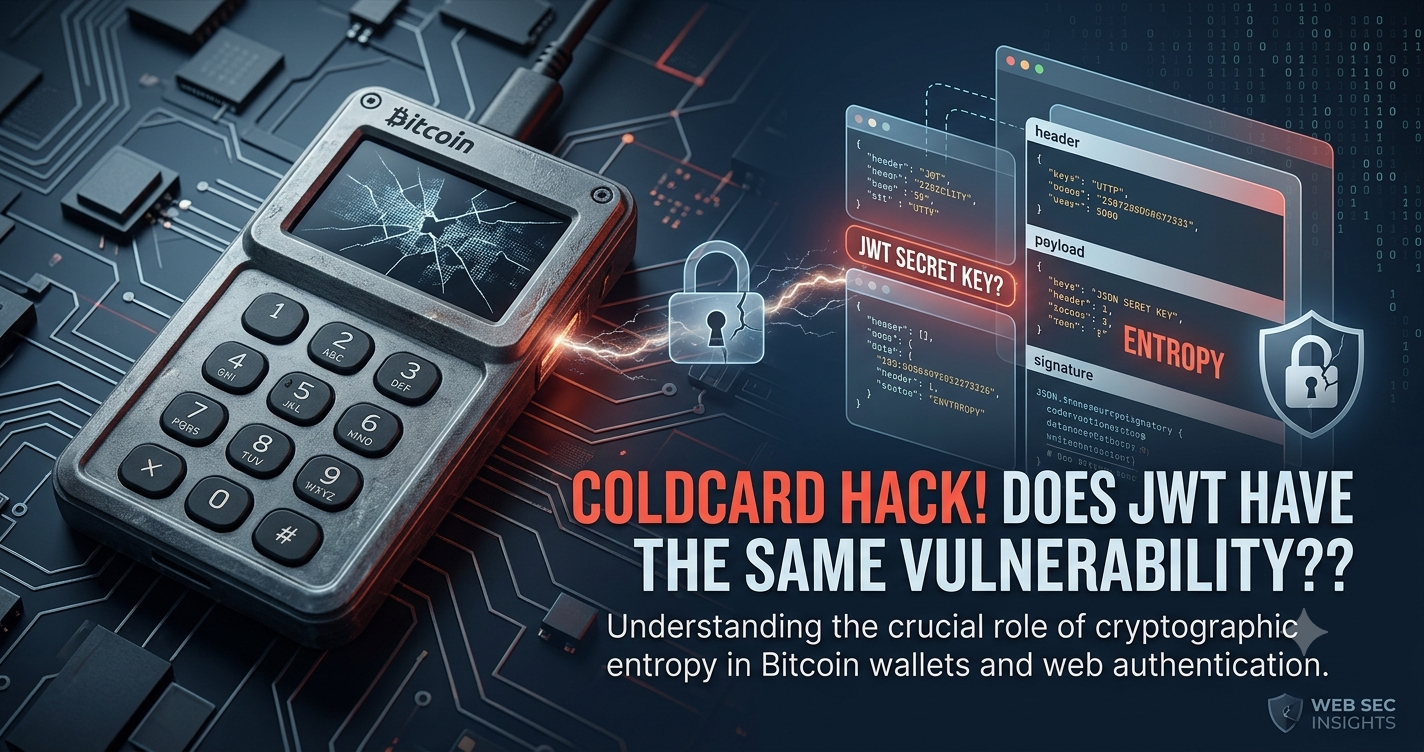
When we think about major cyber attacks, we often picture sophisticated zero-day exploits or targeted phishing campaigns. But in July 2026, an estimated $88M+ in Bitcoin was drained from thousands of crypto wallets due to a much simpler, low-level flaw: weak cryptographic entropy.
While this exploit hit Bitcoin hardware wallets, web developers should pay close attention. If your application relies on JSON Web Tokens (JWT) for authentication, you rely on the exact same foundation: unpredictable, cryptographically secure keys.
So, could your application’s JWT setup suffer from the same vulnerability? Let’s look at what happened, how JWTs relate, and how to protect your application.
What Caused the Coldcard Hack?
The Coldcard hardware wallet (made by Coinkite) has long been considered one of the gold standards for offline Bitcoin storage. However, a low-level software flaw introduced in March 2021 caused the hardware to silently bypass its internal True Random Number Generator (TRNG) when creating new wallet seed phrases.
Instead of using full cryptographic randomness, the firmware defaulted to a deterministic software generator initialized with predictable data—like the chip’s unique ID and internal timer registers.
- Intended Entropy: 128+ bits (virtually impossible to guess).
- Actual Entropy: As low as 40 to 72 bits.
- The Result: Attackers were able to systematically recalculate potential seed phrases offline, derive the matching private keys, and sweep millions of dollars in automated transactions.
Does JWT Have the Same Vulnerability?
In theory, yes. In practice, the mechanics are slightly different—but the root danger is identical.
In cryptography, both hardware wallet seeds and JWT secret keys depend on a Cryptographically Secure Pseudo-Random Number Generator (CSPRNG).
While a Bitcoin seed phrase acts as a Master Root Seed (deriving all public/private key pairs) and a JWT key acts as a Symmetric Secret Key (used to sign payloads), both fail catastrophically if the underlying randomness is weak:
| Feature | Coldcard (Crypto Wallet) | JWT (Web Application) |
|---|---|---|
| Role | Master seed to derive private keys | Secret key to sign & verify tokens |
| Weakness | Software fallback bypassed hardware RNG | Predictable strings or bad PRNG (Math.random()) |
| Exploit | Attacker computes private keys offline | Attacker brute-forces secret to forge admin tokens |
| Impact | Total loss of stored funds | Full account takeover / authentication bypass |
If your JWT secret key was created using a standard, non-secure random function or a short password string, an attacker can capture one of your valid JWTs, run an offline brute-force tool (like Hashcat or John the Ripper), crack your secret key, and generate valid tokens for any user account on your server.
What Makes a JWT Secret Key “Weak”?
Just like the Coldcard bug collapsed 128 bits of security down to 40 bits, developers often accidentally collapse JWT security by using weak inputs:
1. Hardcoded Common Strings
"secret","supersecret","password123","change_me_in_production"
2. Predictable Metadata
"myapp_production_2026","postgres_db_secret"
3. Non-Cryptographic Randomness
Generating secrets using standard pseudo-random generators (like JavaScript’s Math.random()) instead of CSPRNGs (crypto.randomBytes()).
JavaScript
// BAD: Predictable PRNG output (Vulnerable to cracking)
const weakSecret = Math.random().toString(36);

// GOOD: Cryptographically secure 512-bit entropy (Node.js)
const crypto = require('crypto');
const strongSecret = crypto.randomBytes(64).toString('hex');
The Fix: Zero-Downtime JWT Key Rotation
With Coldcard, updating the firmware wasn’t enough—users had to move their funds to a completely fresh seed.
Best practices (and you should ALWAYS be following best practices) is to automate rotating your JWT Secret Key monthly.
To rotate keys without logging everyone out, implement a Key ID (kid) header:
- Maintain Primary & Secondary Keys:Your application uses a Primary Key to sign new tokens, but keeps older Secondary Keys available solely to verify active tokens.
- Pass
kidin the Token Header:JSON{ "alg": "HS256", "typ": "JWT", "kid": "key-2026-v2" } - Verify by
kid:When a request arrives, check thekidheader and use the corresponding secret key to verify the payload. - Retire Old Keys Gracefully:Once the max token lifespan (e.g., 24 hours) passes, you can safely delete the old secondary key from your backend.
Summary Checklist for JWT Security
- [ ] High Entropy: Is your symmetric key at least 32 to 64 bytes (256–512 bits) of cryptographically secure random data?
- [ ] CSPRNG Sourced: Did you use system entropy (like
crypto.randomBytes) rather than basic PRNGs? - [ ] Key Isolation: Is the key loaded purely via environment variables or a dedicated Secrets Manager?
- [ ] Rotation Ready: Do you have a
kid-based rotation scheme to upgrade weak secrets without breaking live sessions?
Leave a Reply