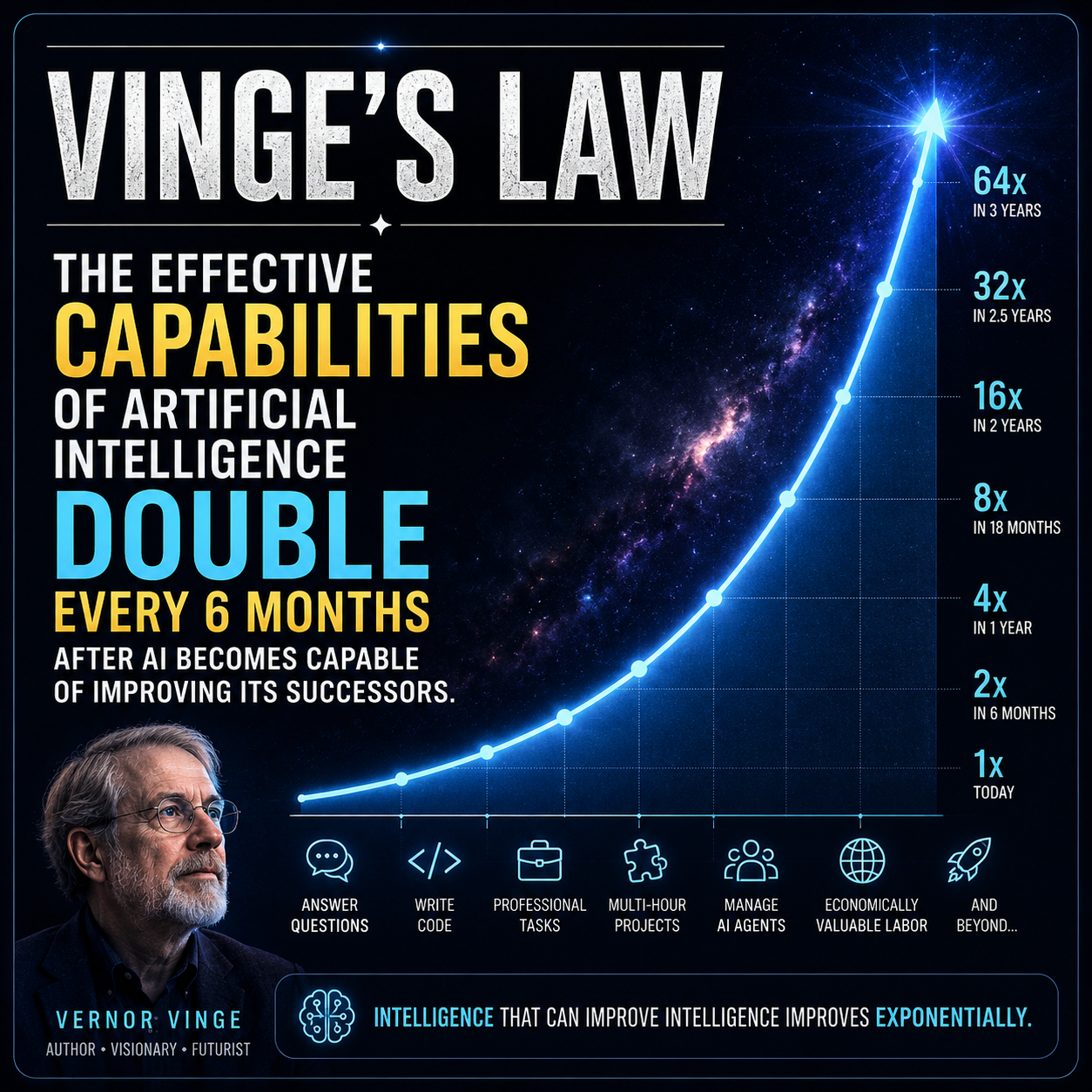
I’d argue that we’ve had a Moore’s Law for silicon for sixty years. It’s time we had one for intelligence.
Vinge’s Law proposes a simple observation about the future of artificial intelligence:
The effective capabilities of artificial intelligence double every six months after AI becomes capable of improving its successors.
Unlike Moore’s Law, which measured the growth of transistor density on silicon chips, Vinge’s Law measures something far more profound: the accelerating growth of intelligence itself.
We’re already witnessing the early stages of this phenomenon. AI systems are writing code that powers AI products. They’re assisting researchers in designing experiments, analyzing massive datasets, generating documentation, discovering optimizations, and increasingly acting as collaborators in their own advancement. The loop has begun.
The moment intelligence becomes a meaningful contributor to the creation of more capable intelligence, the rules change.
Why Six Months?
The six-month figure is intentionally ambitious. Moore’s Law famously wasn’t a law of physics—it was an observation about technological trends that proved remarkably predictive for decades. Vinge’s Law is intended in the same spirit.
If an AI system becomes twice as capable every six months, the implications are staggering:
| Time | Relative Capability |
|---|---|
| Today | 1x |
| 6 Months | 2x |
| 1 Year | 4x |
| 18 Months | 8x |
| 2 Years | 16x |
| 2.5 Years | 32x |
| 3 Years | 64x |
At 64 times today’s capabilities, we’re not talking about marginal improvements. We’re talking about technologies and applications that are difficult for us to even imagine today.
History has shown that humans are notoriously bad at intuitively understanding exponential growth. We tend to think linearly. AI development is increasingly looking anything but linear.
Why Name It After Vernor Vinge?
The name is a tribute to one of science fiction’s great visionaries, Vernor Vinge. I want to be clear he would never be so arrogant as to know something after himself. I was looking for a phrase like Moore’s Law to describe the recent massive growth in AI capability, and decided to go with Vinge’s Law.
Long before artificial intelligence became a household topic, Vinge wrote about the implications of superhuman intelligence and popularized the concept of the technological singularity—the point at which technological progress accelerates so rapidly that it becomes fundamentally unpredictable from a human perspective.
In his influential 1993 essay, The Coming Technological Singularity, Vinge wrote:
“Within thirty years, we will have the technological means to create superhuman intelligence. Shortly thereafter, the human era will be ended.”
Whether or not his timeline was correct is almost beside the point. Vinge recognized something that many technologists are only now beginning to appreciate: intelligence is different from every other technology we’ve ever invented. Intelligence is the technology that invents technologies.
Once intelligence begins improving intelligence, progress ceases to be additive and becomes multiplicative.
That insight makes Vernor Vinge the perfect namesake for a law describing the exponential growth of machine intelligence.
Intelligence Improving Intelligence
Notice that Vinge’s Law doesn’t require AI to lock itself in a datacenter and recursively retrain its own neural networks.
Human beings remain part of the loop.
Today’s AI models are already helping engineers write software. Tomorrow’s models will help design better architectures. The next generation may help conduct scientific research, discover new algorithms, optimize hardware designs, and coordinate teams of both humans and machines.
The distinction between “AI improving itself” and “AI helping improve its successors” is largely academic. The effect is the same: every generation becomes a more capable participant in creating the next generation.
Eventually, the question won’t be whether AI is improving AI. The question will be how quickly.
The New Arms Race
Moore’s Law transformed industries. Vinge’s Law has the potential to transform civilization itself.
If Vinge’s Law proves even approximately correct, the organizations and individuals who understand exponential intelligence will possess an enormous advantage over those who continue planning for a world that changes incrementally.
The next decade may not simply be “the AI revolution.” It may represent humanity’s transition from being the sole creators of intelligence to becoming collaborators with it.
That’s a much bigger story than faster computers.
It’s the story of intelligence itself becoming an exponentially improving technology.
Where to Start Reading Vernor Vinge
If you’ve never read Vernor Vinge, you’re in for a treat. Much of modern thinking about artificial intelligence, technological acceleration, and the singularity owes a debt to his work.
Some excellent places to start:
- A Fire Upon the Deep – Perhaps his masterpiece, exploring superintelligent civilizations and the nature of intelligence itself.
- A Deepness in the Sky – A brilliant prequel featuring one of the most fascinating depictions of technology and human societies in science fiction.
- Rainbows End – Remarkably prescient in its predictions of augmented reality, ubiquitous computing, and AI-assisted society.
- The Coming Technological Singularity – Required reading for anyone interested in the future of artificial intelligence.
You can find all of these titles on Amazon in both physical and Kindle editions.
Vinge’s Law
The effective capabilities of artificial intelligence double every six months after AI becomes capable of improving its successors.
If Moore gave us the law of computing, perhaps Vinge can give us the law of intelligence.
Where Does It End?
Science fiction has a habit of asking the right questions decades before science can answer them. Vernor Vinge spent much of his career contemplating what happens when intelligence itself becomes the fastest-improving technology in existence. The honest answer is simple: we don’t know.
No law of exponential growth lasts forever. Physics eventually collects its debt.
Processors can only become so small. Computation requires energy. Heat must be dissipated. Information can travel no faster than the speed of light. There is no technological breakthrough waiting for us that repeals the laws of the universe.
Even a superintelligence must obey Einstein.
But that observation shouldn’t make us skeptical of Vinge’s Law. Quite the opposite. It should make us appreciate how extraordinary the journey between here and those physical limits may be.
Imagine trying to explain the Internet to Isaac Newton. Or modern medicine to Julius Caesar. Humanity has repeatedly demonstrated that technologies can become so transformative that they are indistinguishable from magic to those who came before them. Artificial intelligence may be the first technology capable of helping invent its own successors, accelerating that process beyond anything in human history.
If Vinge’s Law proves even approximately correct, the most important question of the 21st century will not be, “How smart will AI become?” It will be, “What does intelligence do when it is no longer the bottleneck?”
For all of human history, progress has been constrained by our ability to think. Our greatest scientists and engineers have been precious and scarce resources. Every civilization has ultimately been limited by the number of brilliant minds it could produce.
For the first time, we may be approaching a world where intelligence itself can be manufactured, scaled, and improved.
The constraints of the future may not be imagination or intellect, but energy, matter, and the fundamental architecture of the universe. The bottleneck shifts from “Can we figure it out?” to “Will physics allow it?”
That is a remarkably good problem to have.
Perhaps the most Vinge-like answer to the question “Where does it end?” is that it doesn’t end in any way we can meaningfully predict. The technological singularity was never a prediction of flying cars or robot servants. It was an acknowledgment that sufficiently advanced intelligence changes the very nature of prediction itself.
Vinge’s Law is not a claim that AI will become infinitely intelligent. It is a recognition that once intelligence begins improving intelligence, we have crossed a threshold from which history may no longer proceed at a human pace.
Moore’s Law gave us better computers. Vinge’s Law may give us something far stranger: a future that even our greatest science fiction writers could only glimpse through a glass, darkly.
And if Vernor Vinge taught us anything, it’s that the most exciting discoveries lie just beyond the limits of our imagination.
Leave a Reply