this post formatted by AI for clarity, typos and readbility
For the last fifteen years, software engineering has largely been a search for leverage through abstraction.
Frameworks promised that if we accepted enough structure, conventions, lifecycle rules, and tooling complexity, we could dramatically reduce the amount of code humans had to write and maintain.
And for a long time, that trade made sense.
React solved UI synchronization chaos. React Native reduced duplicated mobile effort. TypeScript reduced runtime mistakes. Build systems normalized wildly inconsistent browser environments. Entire ecosystems emerged to manage state, effects, hydration, routing, memoization, data fetching, rendering pipelines, and asynchronous synchronization.
The industry optimized around one central question:
How do we avoid writing code?
But AI changes the economics of software development so fundamentally that we may be entering a new phase entirely:
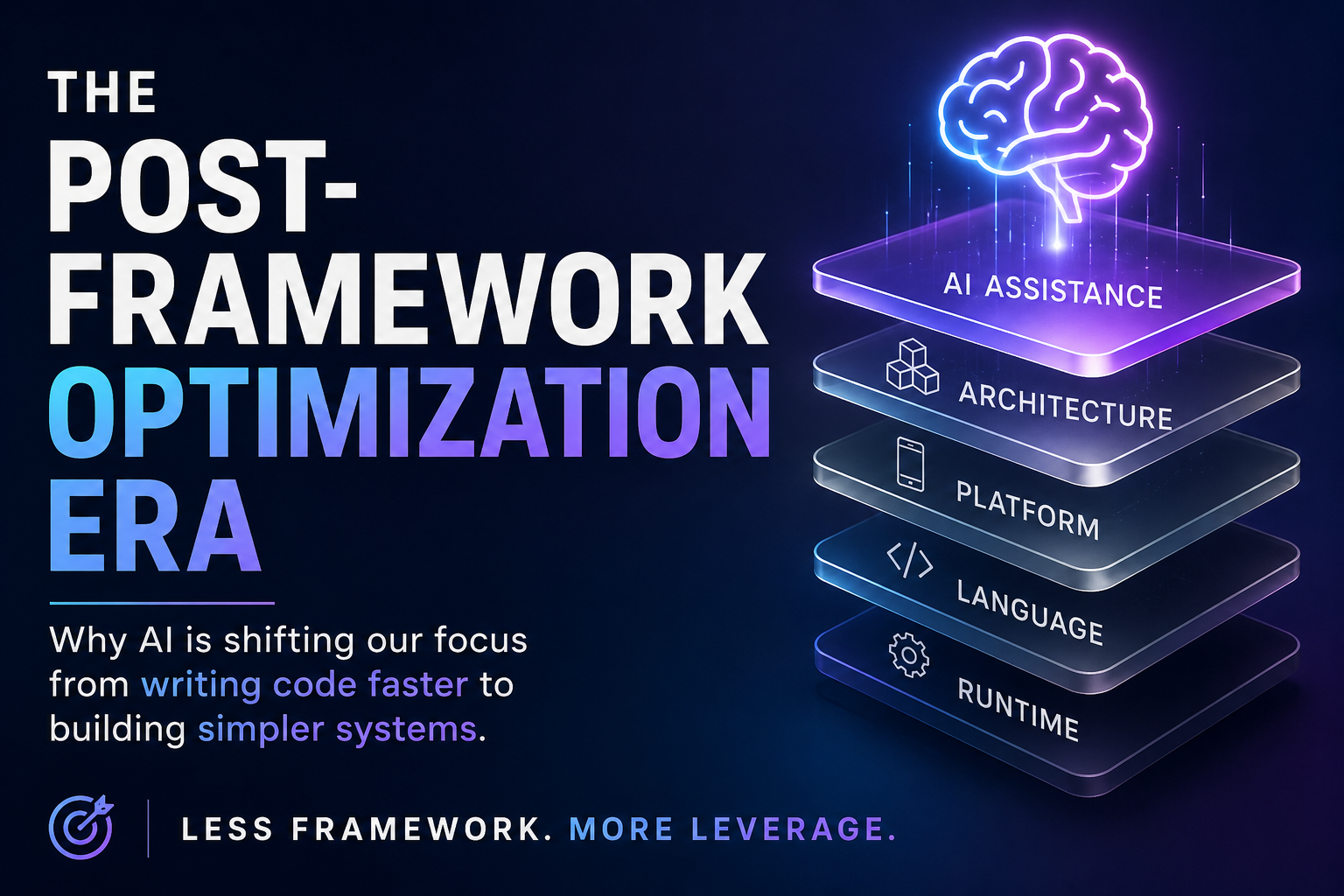
The post-framework optimization era.
Not an era without frameworks — but an era where the cost of abstraction itself becomes more visible than the cost of code generation.
Frameworks Were Primarily Labor Optimizers
This is easy to forget now.
Many modern frameworks were not invented because software complexity disappeared. They were invented because humans struggled to manage that complexity manually at scale.
React solved:
- tangled DOM mutation logic
- state synchronization bugs
- event management chaos
- inconsistent rendering flows
React Native solved:
- duplicated iOS and Android teams
- platform-specific feature divergence
- mobile hiring constraints
TypeScript solved:
- large-scale maintainability
- refactoring safety
- implicit contracts
These systems optimized for human cognitive limitations and organizational scaling problems.
But AI directly attacks those bottlenecks.
AI is remarkably good at:
- boilerplate generation
- repetitive glue code
- API translation
- scaffolding
- refactoring
- enforcing patterns
- filling in ecosystem knowledge gaps
Historically, learning Kotlin or Swift represented substantial friction for a JavaScript-centric team. Today, AI dramatically compresses that penalty.
That changes the equation.
The Hidden Cost of Frameworks
As frameworks matured, they accumulated a second-order complexity of their own.
React eventually became:
- hooks
- effects
- dependency arrays
- memoization strategies
- concurrent rendering
- Suspense
- hydration semantics
- server/client boundaries
- build pipelines
- reconciliation edge cases
Ironically, we solved DOM complexity by inventing framework complexity.
This tension is visible even within React’s own evolution.
A few years ago, developers treated useEffect as the default mechanism for application logic:
- syncing state
- filtering data
- triggering derived updates
- orchestrating renders
Now the React team explicitly teaches:
“You Might Not Need an Effect.”
That statement reflects a deeper philosophical shift.
The modern React model increasingly says:
- derive state instead of synchronizing it
- prefer pure render logic
- treat effects as escape hatches
- minimize lifecycle coupling
This wasn’t just stylistic guidance. It was architectural pressure caused by:
- Concurrent Rendering
- Suspense
- replayable rendering
- interruptible rendering
- server-first models
React itself began moving away from imperative synchronization patterns.
That trend matters.
The Browser Grew Up
Another reason frameworks are being reevaluated is simple:
the browser became dramatically more capable.
Modern browsers now provide:
- modules
- async/await
- fetch
- Web Components
- CSS variables
- strong selector APIs
- template literals
- shadow DOM
- native animation primitives
Many older frameworks compensated for limitations that no longer exist.
The result is that the abstraction-to-benefit ratio shifted.
Developers increasingly ask:
“Do I really need a virtual operating system in the browser for this application?”
For many apps, the answer is now “probably not.”
AI Changes What We Optimize For
This may be the most important shift underway.
For years, the dominant optimization target was:
minimizing the amount of code humans must write.
But AI reduces the marginal cost of code generation so aggressively that the bottleneck moves elsewhere.
The new optimization target becomes:
minimizing architectural complexity.
That is not the same thing.
A framework can reduce duplicated code while simultaneously increasing:
- abstraction layers
- lifecycle semantics
- hidden coupling
- runtime machinery
- debugging difficulty
- cognitive overhead
As AI lowers implementation cost, those abstraction costs become harder to justify.
This Applies to Mobile Too
The same logic increasingly affects React Native.
Historically, the strongest argument for React Native was:
“One JavaScript team can ship both platforms.”
But if AI can now help developers generate:
- Swift
- Kotlin
- native bindings
- platform-specific adapters
then the productivity gap between native and cross-platform development narrows substantially.
That doesn’t eliminate the value of React Native. It still provides enormous leverage for:
- startups
- SaaS products
- small teams
- shared web/mobile ecosystems
But the justification changes.
The question is no longer:
“Can we afford native development?”
It becomes:
“Does the abstraction layer reduce more complexity than it introduces?”
That is a much sharper architectural question.
What Survives the Transition?
The future is probably not “everyone writes raw JavaScript.”
Complexity still exists:
- async coordination
- rendering consistency
- caching
- synchronization
- navigation
- state management
- accessibility
- distributed systems behavior
AI does not eliminate these problems.
What likely survives are abstractions that:
- remove true conceptual complexity
- align with platform behavior
- preserve debuggability
- minimize hidden lifecycle semantics
- avoid excessive runtime indirection
What likely declines are abstractions that primarily exist to reduce typing effort or compensate for historical ecosystem weaknesses.
The Emerging Direction
The industry already shows signs of this transition:
- server-first rendering
- thinner client runtimes
- island architectures
- fine-grained reactivity
- partial hydration
- compiler-assisted UI systems
- schema-driven rendering
- direct platform APIs
- effect minimization
Even React itself increasingly pushes developers toward:
“UI is a pure function of state.”
That is fundamentally simpler than:
“manually synchronize stateful systems through lifecycle orchestration.”
The Real Shift
The most important realization may be this:
AI weakens the importance of programming language specialization more than it weakens the importance of architecture.
In other words:
- generating Java is easier
- generating Swift is easier
- generating JavaScript is easier
But operating coherent systems remains hard.
The future of software engineering may therefore become less about:
“Which framework writes less code?”
and more about:
“Which architecture produces the least operational and conceptual complexity?”
That is a very different optimization function than the one that shaped the last decade of software development.
Leave a Reply